
Flat Signs and Panel Signs in Philadelphia
One panel, cut and finished to fit the wall you have. The most direct way to get your name up, inside or out.
The Sign Without the Wiring
A flat sign is exactly what it sounds like: a rigid panel with your name on it, mounted to a wall, a fascia, or a pair of posts. No cabinet, no LEDs, no electrician. That simplicity is the point, and it is why flat signs cover everything from a rowhome storefront in South Philly to a suite number down a hallway in Bala Cynwyd.
Simple does not mean cheap looking. The difference between a flat sign that reads professional and one that reads homemade is material choice, edge finish, and letterform. A routed aluminum panel with dimensional letters standing off the face has real shadow and depth. A printed panel screwed flat to brick does not. We will show you both and tell you what each one costs.
Every panel is drawn by our design team against a photo of your actual building, then cut and finished in our Woodhaven Road shop. Graphics come off our own print equipment, so a panel, a matching window graphic, and a banner all come out of the same file with the same colors.
Anatomy of a Panel Sign
From the sidewalk a flat sign reads as one piece. Up close it is a layered sheet, a set of standoffs, and whichever copy treatment you picked.
- ACM panel. Aluminum composite, the flat sheet the whole sign is built on. It stays flat and it does not rot.
- Aluminum skins. The two thin metal faces bonded to each side. They hold paint, print, and vinyl, and they take the weather.
- Core. The plastic center between the skins. It is what keeps the panel light and stiff at the same time.
- Standoffs. Round barrels that hold the panel off the wall, so the sign casts a shadow line and water runs behind it.
- Applied vinyl copy. Cut or printed graphics laid onto the finished face. The fastest and least expensive treatment.
- Routed copy. Letters cut clean through the panel on our router, backed with acrylic so they can push through or light later.
- Dimensional letters. Individual letters mounted off the face on studs, for real depth and a hard shadow.
Materials, and How the Copy Goes On
The panel material sets the shelf life. The copy treatment sets the price. Here is how each choice plays out on a real building.
Aluminum Composite
Two thin aluminum skins bonded to a plastic core, sold as ACM or under trade names like Dibond. Light, flat, stiff, and it will not rot or swell. This is the workhorse for exterior wall panels, and it takes both printed vinyl and applied letters cleanly.
PVC
Expanded PVC board cuts crisp, paints well, and costs less than metal. It is the right call for interior signs, lobby panels, and protected exterior spots. We steer people away from it on a large sun-facing wall, because it moves with heat and a big sheet can bow.
HDU
High-density urethane, the material behind most carved signs. It routes deep, holds sharp letterforms, and shrugs off weather that would destroy real wood. HDU is how you get a traditional carved look on a Chestnut Hill or Doylestown block without a maintenance problem in three years.
Solid Aluminum
Heavier plate for post-and-panel signs, parking and directional signs, and anywhere a panel is going to get bumped. It costs more and it lasts accordingly.
Routed Faces
We cut the copy straight through the panel on the router. Backed with acrylic, the letters can be pushed through the face for a raised, tactile read, and the whole thing can be lit from behind if you add a light box later. The highest end of the three copy treatments, and it looks it.
Applied Vinyl
Cut or printed graphics applied to a finished panel. Fastest, least expensive, and completely fine for a logo with fine detail or a full color image. The tradeoff is that vinyl on a south-facing wall fades before the panel does, so plan on refreshing the graphics sooner than the sign itself.
Dimensional Letters
Individual letters in cast metal, fabricated aluminum, or acrylic, mounted with studs and standoffs so they sit off the panel. Real depth, real shadow, and the look most professional offices want. This is also the middle ground for anyone pricing channel letters and finding them out of reach.
Where Flat Signs Are the Right Answer
Outside, flat panels carry storefronts on walkable blocks, secondary elevations that face a parking lot, service doors, and any tenant whose landlord wants a uniform look across a center. Property managers lean on them for exactly that reason: a run of matched panels reads as one building, and swapping a panel when a tenant leaves is a same-day job.
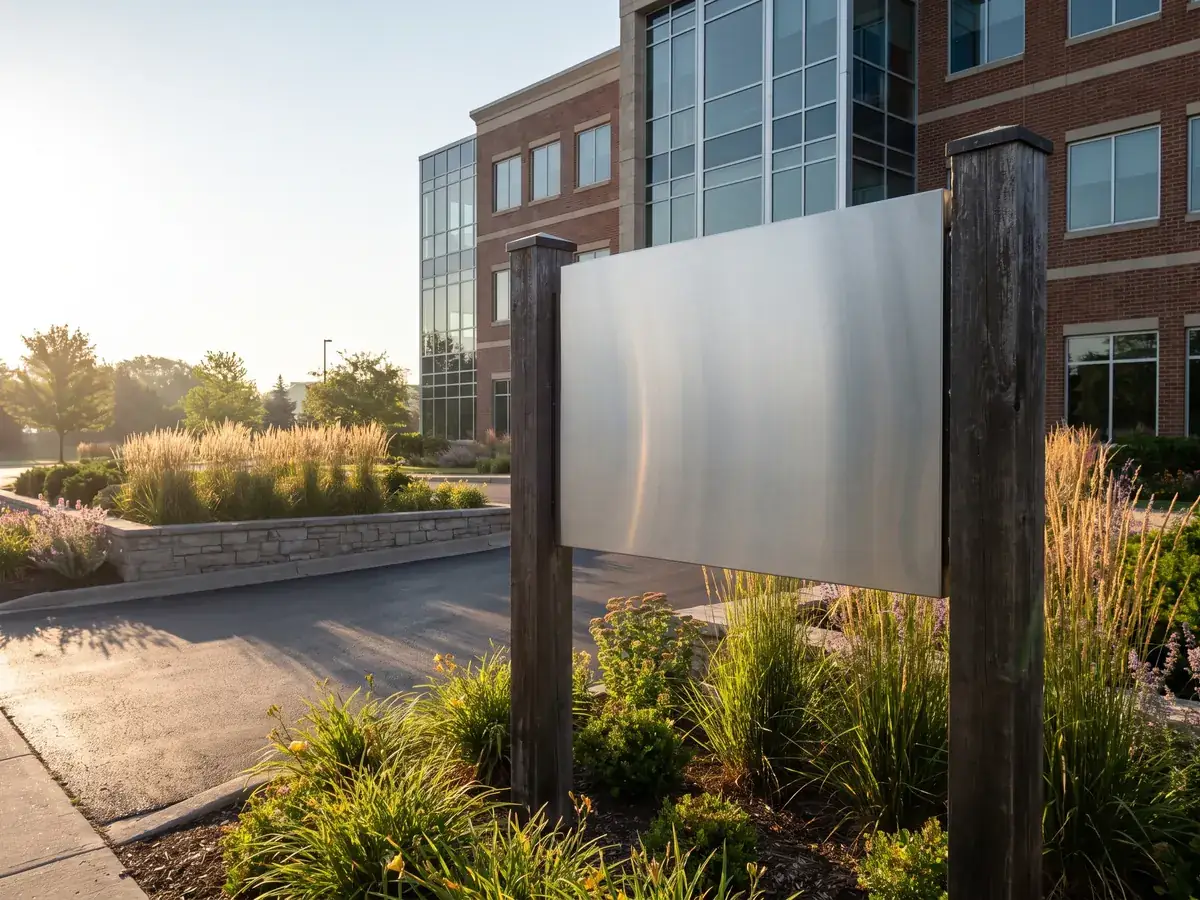
Put the same panel on two posts instead of a wall, set in concrete footings, and you have a post-and-panel sign. That is the answer when the building is too far from the road to carry its own name: offices behind a parking lot, apartment communities, and industrial parks where the driveway matters more than the facade.
Inside is where flat signs quietly do the most work. Lobby signs behind the reception desk, suite numbers, directories, restroom and exit signage, and department routing down a corridor. Medical and professional offices usually need all of it at once, on a schedule tied to a fit-out.
Interior signs that identify a permanent room or space typically have to meet ADA rules: raised characters, Grade 2 braille, a non-glare finish, contrast between copy and background, and a set mounting height on the latch side of the door. We build to those requirements and keep the finish consistent with the lobby piece, so a compliant sign does not look like an afterthought bolted on later.
The honest comparison most buyers want:
- Choose a flat sign when your customers arrive in daylight, the storefront is close to the sidewalk, the landlord's sign criteria call for panels, or the budget will not carry a lit sign this year.
- Choose channel letters or a light box when you trade after dark, when the sign faces traffic moving at speed, or when every neighbor on the block is lit and you would be the dark storefront.
- Start flat and upgrade later. A well-placed panel today does not block a lit sign in two years. Tell us the plan and we will size the panel so the wall work is not wasted.
One caution: non-illuminated does not mean unregulated. Exterior wall signs in the city typically still need an L&I sign permit, and townships review size and placement the same way they would for a lit sign. Our surveys and permitting team confirms it before we cut anything.
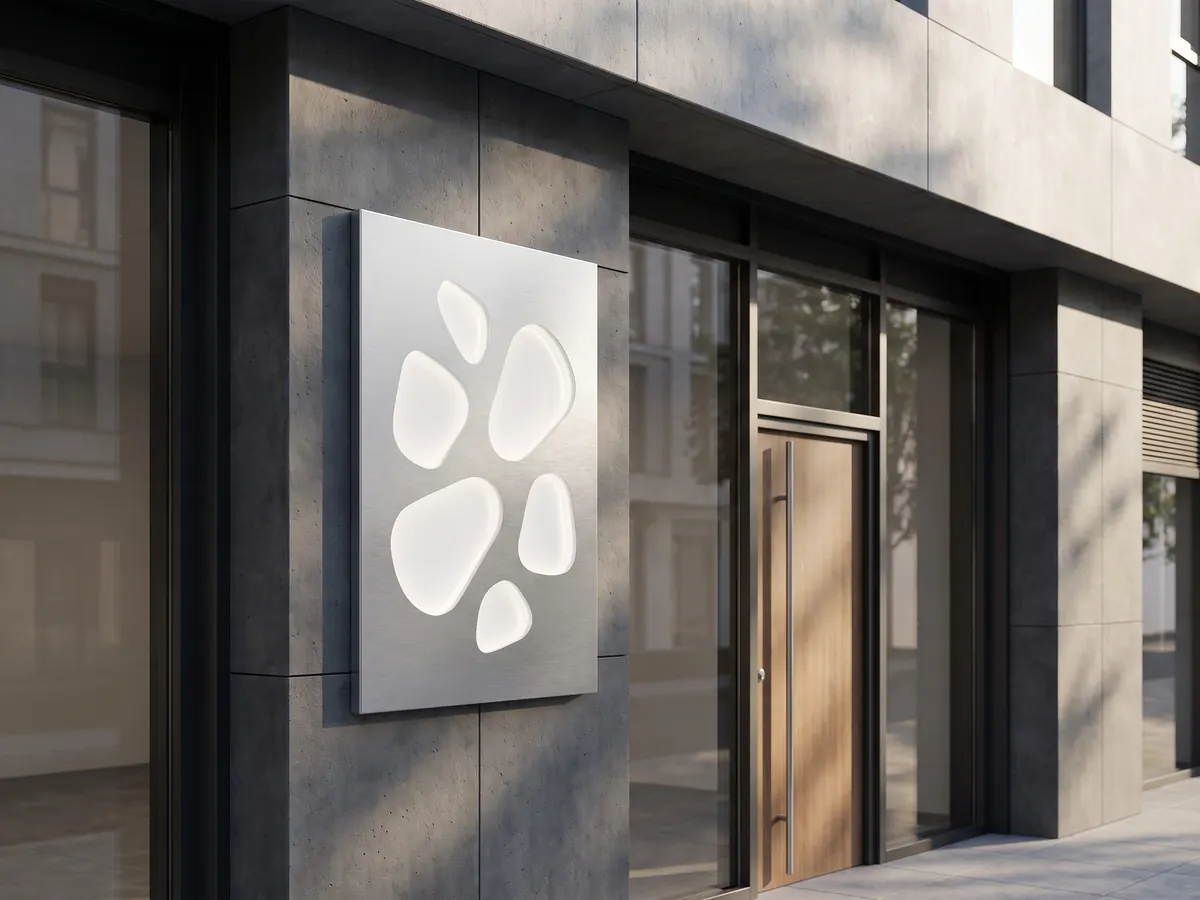
Panels In Place
A few recent builds. Tap any photo to enlarge it.
Flat Sign Questions
Are flat signs cheaper than channel letters?
Usually, and often by a wide margin. A flat sign is one panel with graphics on it instead of a set of individually built, individually wired letters. There is less metal, less labor, no electrical work, and a shorter install. For a tenant with a lease sign budget, that gap is frequently the difference between a sign this month and a sign next year.
What material should I use for an outdoor panel sign?
Aluminum composite is the default for flat wall panels. It is light, stiff, and it does not rot or warp through a Philadelphia winter. Solid aluminum suits post-and-panel signs that take abuse. HDU is the pick when you want a carved, dimensional look. We steer people away from PVC on sun-facing exterior walls because it moves with heat.
Do you make ADA-compliant interior signs?
Yes. Permanent room and space signs typically need raised characters, Grade 2 braille, a non-glare finish, and contrast between the copy and its background, mounted at a set height beside the latch side of the door. We build suite numbers, restrooms, and exit routing to those rules and keep the look consistent with your lobby sign.
Do I need a permit for a flat wall sign in Philadelphia?
For an exterior wall sign, in most cases yes. Non-illuminated does not mean unregulated, and a flat panel is reviewed for size and placement like any other wall sign. Interior signs behind the glass usually do not need one. We confirm before we build, and we file the application when it is required.
Get Your Name on the Wall
Send a photo of the wall and the name that goes on it. We will spec the panel, price the options, and tell you which one we would buy.
267-344-8492