
Mitsubishi Dealership Signage Set by Crane
Two photographs, two lifts, two different sign types. One is a pole cabinet being guided onto its steel. The other is a brand fascia band going up onto a dealership parapet.
Lift One: the Pole Cabinet
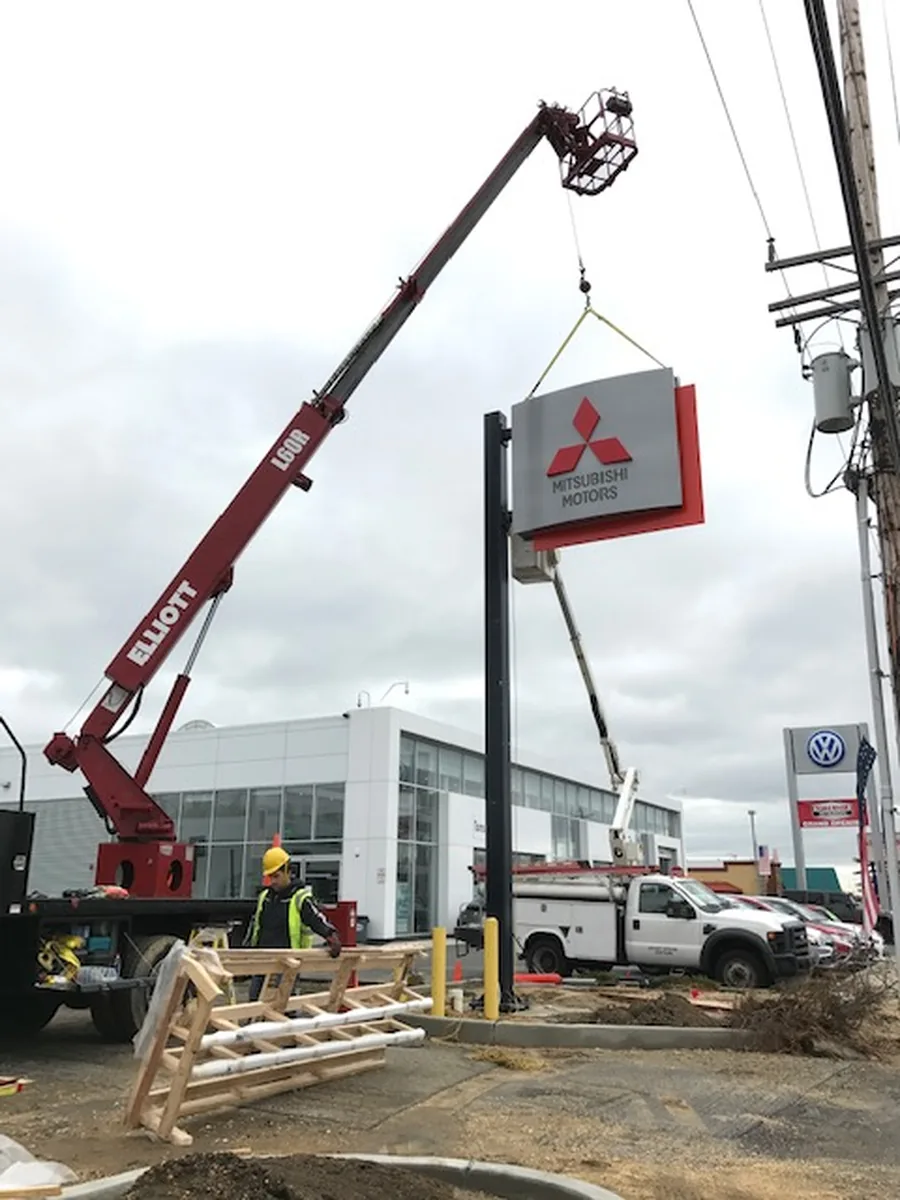
A shaped cabinet carrying the three-diamond mark above the MITSUBISHI MOTORS wordmark hangs from the crane line on a two-leg sling, held just clear of the black steel pole it is about to sit on. The cabinet face is silver-grey with a red panel wrapping the right-hand edge and a red band running under the bottom. A grey box is already fixed to the pole directly below where the cabinet will land.
A crew member in a yellow hard hat and a high-visibility vest stands on the ground beside the crane truck, off to the side of the pole and out from under the cabinet. That is where he belongs. Nobody stands under a suspended load.
The ground around the base of the pole is still open dirt, with bollards already set, fresh concrete edging poured, and timber racking stacked in the foreground. A pole like that one goes in on its own footing and cures before any weight is hung on it, which is why the pole is standing alone in the photograph and the cabinet is still on the hook.
A utility pole carrying a transformer runs up the right edge of the frame, within sight of the boom. Overhead power decides where a crane truck can set its outriggers, and it is worked out at the survey rather than on the morning of the lift.
Lift Two: the Fascia Band
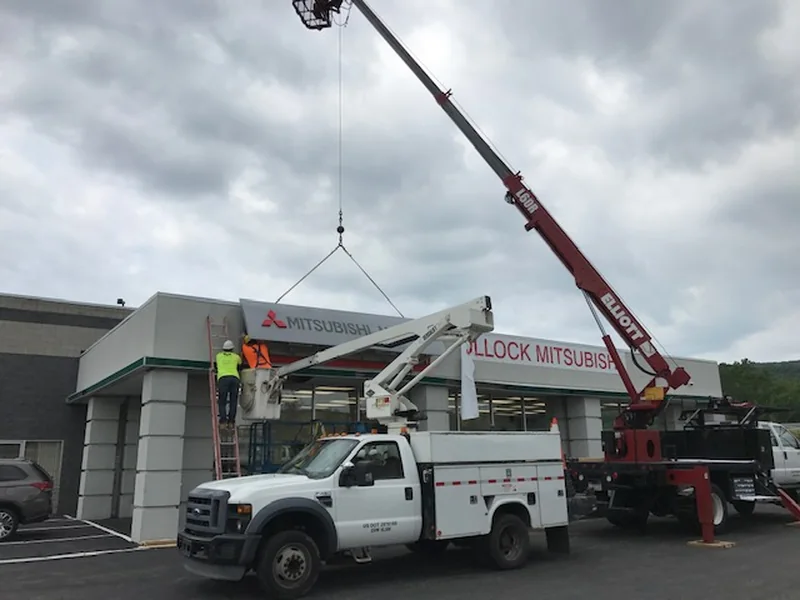
A long white sign band carrying the three-diamond mark and the MITSUBISHI wordmark hangs from the crane line on a two-leg sling, just off the parapet it is going onto. The band is tipped down at the left end, where the crew is standing ready to take it. Where the sling legs are choked along a band that long decides how it hangs, and how it hangs decides whether it lands in one move or gets fought against the building.
The dealer name band is already up on the elevation below and to the right, white with red letters. The brand panel is going on above it, so the building ends up carrying the manufacturer mark and the dealer name as two separate signs.
Two workers are at the left end of the band where it will land, one on a ladder and one in the basket of a bucket truck. A crane holds the weight and a bucket puts hands on the sign. Most fascia work above ladder height needs both machines on site at once.
A service truck with a utility body sits in the foreground and the boom comes in from the right. The building is glazed, the canopy is finished and the lot is paved, so the sign went onto a completed building rather than a bare shell.
Project Specs
- Client
- A Mitsubishi dealership
- Location
- Not established from the photographs
- Sign types
- A pole-mounted sign cabinet on its own steel, and a wall-mounted brand fascia band
- Rigging
- Two-leg sling off the crane line on both lifts
- Equipment
- An Elliott boom truck on both lifts, with a bucket truck on site in both photographs and in the basket on the fascia lift
- Site conditions
- Overhead utility lines beside the pole lift; a finished, glazed building and a paved lot under the fascia lift
- Industry
- Auto dealers and shops
- VH scope
- Installation
Brand Signage, Live Lots, and the Crane
- The sign usually arrives already designed. Franchise dealers generally receive the main brand sign through the manufacturer's image program, built by that program's national vendor. We say the same thing on our auto dealer page and we do not pretend to replace those programs. What a dealership needs locally is the crew, the crane and the electrical to put the sign where it belongs, plus everything the program leaves out.
- Two sign types, one visit. A dealership carries a road sign and a building sign, and they are different animals. The pole sign needs a footing, a pole and a cabinet. The fascia band needs a parapet that can take it and a crew working off two machines. Both of them ride up on our own crane trucks.
- The lot is rarely empty. Neither photograph is a bare construction site. Glass is in, the buildings are finished, and there are cars on the pavement in both. A crane truck needs a setup area, an outrigger footprint and a boom path through all of that, and sequencing the pick around it is the part of installation that never shows up in a photograph.
- Power is the first constraint, not the last. The transformer at the edge of the pole-lift frame is the reason the truck is set where it is. Setup area, boom path and overhead lines get settled during the site survey.
- Closures and paperwork. Working over a sidewalk or taking a lane typically needs a closure permit, and townships each have their own rules. We file that through surveys and permitting as part of the job.
- After the image program moves on. A national vendor is a long way from a dark cabinet on a Tuesday. Service and parts entrances, lot directionals and the repairs nobody else will chase are steady local work.
Our crane trucks also take outside lifts. Sign shops without a boom and contractors who need a single pick can book the truck and the operator. Call the office with the site, the height and the weight.
Have a Sign That Needs a Crane?
Send us the site address, the mounting height, and what is going up. We will confirm the right truck before anything gets scheduled.
267-344-8492