
Langhorne Speedway Diner Pylon With an LED Message Board
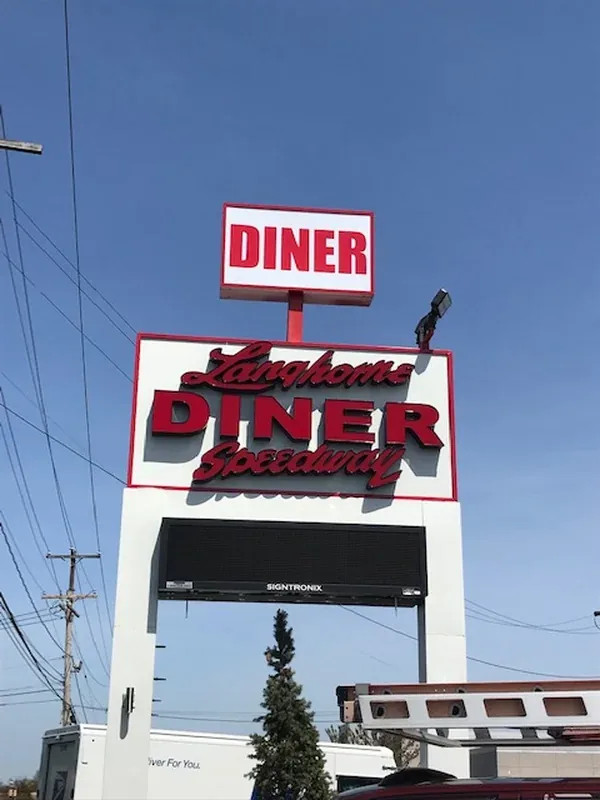
Two sign cabinets on one white pylon, with a full-width electronic display underneath. The cabinets carry the name. The display carries whatever the diner wants to say this week.
What the Photograph Shows
A small cabinet sits at the very top of the sign on a short red post and reads DINER in red on a white face. The larger cabinet below it carries the name in red dimensional lettering: Langhorne in script across the top, DINER in heavy block letters through the middle, Speedway in script underneath, all inside a red border on a white face.
Note which word is biggest. The name is set in script and the category is set in block capitals, because at road speed the word that earns the turn is DINER. That decision is made on the drawing, not at the install.
Below the main cabinet, a full-width electronic message board spans the sign between two white uprights. That is the part the diner rewrites. A floodlight fixture is mounted at the top edge of the main cabinet and aimed down across the face.
Under the display, the white structure carries on down toward grade. Utility poles and overhead lines cross the frame behind the sign. Overhead wire is ordinary on a commercial road, and it is one of the constraints that gets settled at the survey rather than on the morning of the lift.
Project Specs
- Client
- Langhorne Speedway Diner
- Location
- Free-standing at the road, in front of the diner
- Sign type
- Pylon sign with an electronic message board
- Structure
- A white pylon structure carrying the main cabinet, with the display set between two uprights below it and a smaller DINER cabinet on a short post above
- Copy
- Red dimensional lettering on white faces, inside red cabinet borders
- Display
- Full-width LED message board mounted under the main cabinet
- Lighting
- A floodlight fixture on the top edge of the main cabinet, aimed down across the face
- VH scope
- Installation
Pylon Plus Display, Step by Step
This is the route we run when a free-standing sign has to carry changeable copy. It is the same path set out on our pylon sign and message board pages.
- Zoning before design. Height and area limits for free-standing signs vary block by block in Philadelphia and township by township in the suburbs. Changeable displays get more scrutiny than any other sign type, and some districts allow a static sign but no changeable copy at all. Our surveys and permitting team pulls the rules for the address first.
- Size the display to the sight line. Pixel pitch is the gap between the LEDs, and the right pitch depends on how far back the reader actually is. A board facing traffic does not need the resolution a walk-up board needs, and buying pitch nobody is close enough to see is the usual way to overspend on an electronic message board.
- Engineering and footing. A free-standing sign carries wind load, so permits typically call for sealed engineering drawings and a concrete footing sized to the sign and the soil.
- Power and dimming. An illuminated pylon needs a feed at the base, planned during the survey. Every display we install carries a photocell that reads ambient light and dims the board automatically. Run a board at daytime brightness once the sun is down and you get complaints from neighbors, glare for drivers, and a call from the zoning officer.
- The set. Cabinets and display go up in planned picks on our own crane trucks, with a VH operator on the controls and our own crew on the rigging.
- After the install. A message board is electronics living outdoors. Power supplies fail and modules go dark, so repair and maintenance is part of owning one.
A diner runs on the same read a restaurant needs: the name from far enough back that a driver can still make the turn, and the offer close enough to read at the light. A pylon does the first job and the board under it does the second.
Want a Board Under Your Sign?
Send us the address. We will check whether changeable copy is allowed there, measure the sight line, and price the sign against it.
267-344-8492